Who's Getting the Degrees?
Among 25-34 year-olds with a bachelor's degree or higher, women are the majority in 13 of 14 large OECD countries.
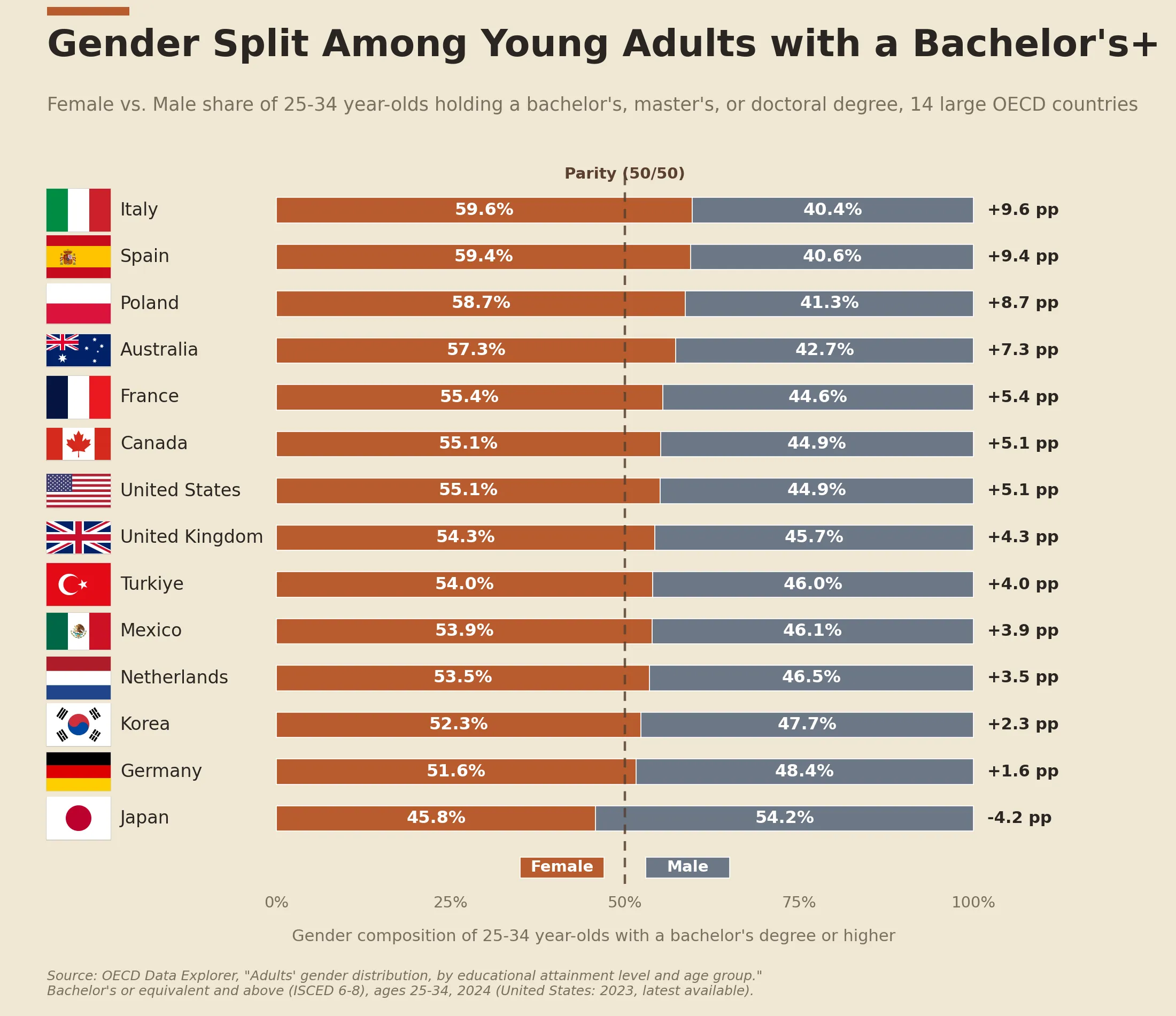
Italy leads at 59.6% female, meaning roughly three women hold a bachelor’s or higher for every two men. Japan is the sole exception: 54.2% male. That reversal traces partly to Japan’s large junior college (tanki daigaku) system, which skews heavily female. Those 2-year credentials count as tertiary but fall below bachelor’s level, so excluding them flips Japan’s gender balance.
A natural question I had was: do these countries simply have more women in that age bracket? I investigated, and the opposite is true. In 13 of these 14 countries, men outnumber women at ages 25-34 (Korea is the most skewed, at 87.8 women per 100 men). The attainment-rate chart below controls for population size, showing what percentage of each gender holds a degree.
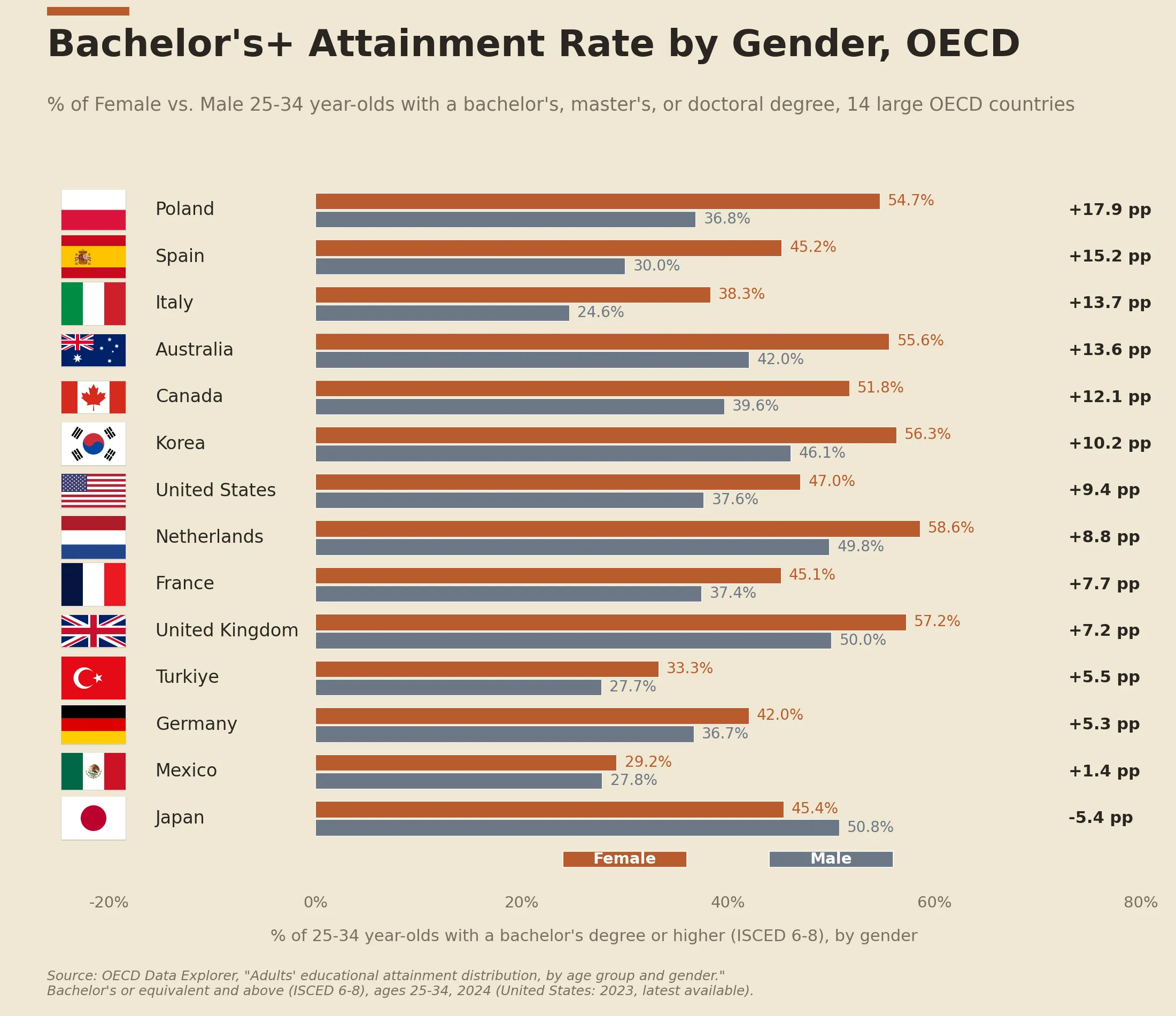
Poland’s gap is the widest: 54.7% of young women hold a bachelor’s or higher, compared to 36.8% of young men. Mexico is the closest to parity at +1.4 pp.